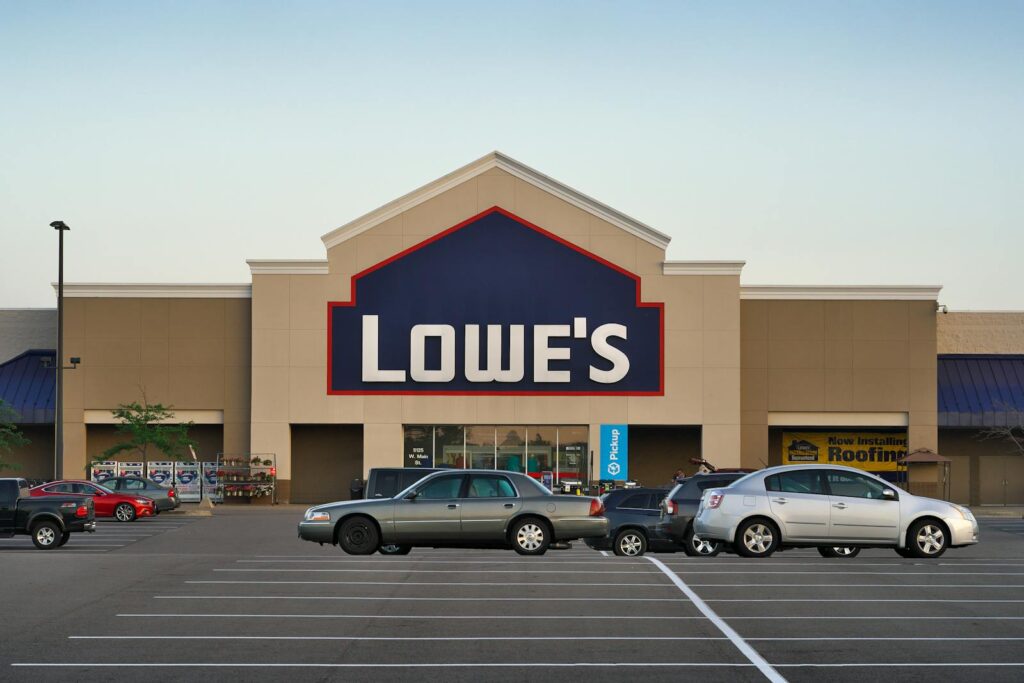
Lowe’s Safety Controversy: Viral Video of Lift Operation Incident Sparks Debate
A recent viral video circulating on social media featured a Lowe’s employee struggling to manage a large box while using a store lift, sparking a crucial conversation among current and former employees about safety protocols and training in the home-improvement retail chain. This video, which captured significant attention online, depicted the employee appearing distressed while attempting to retrieve an item from a high shelf, raising serious questions about operational safety.
The incident captured in the video depicted the employee positioned on a Ballymore Drivable Power Stocker Lift. As the employee worked to handle the large box, he became reportedly wedged between the item and a railing on the lift. During the struggle, the employee could be heard yelling for help, according to accounts of the video. The footage was reportedly filmed by a customer inside the store.
Witnesses to the event included other employees. One employee was reported to be heard encouraging the worker on the lift during his efforts, while another employee present reportedly commented, advising that the action being taken was “that’s not a good idea.” The video highlighted a moment of apparent difficulty and potential hazard in a common retail task.
The employee featured in the viral footage, who was based at a Lowe’s location in Louisiana, reportedly made the decision to quit his position following the video’s widespread circulation. According to reports, the employee quit on Feb. 17, shortly after the video gained viral status on platforms like TikTok. The reason cited for his departure was fear for his personal safety.
A relative of the employee conveyed concerns that the individual was afraid of the possibility of people coming to the store specifically to harass him following the unwanted online attention. The relative also indicated that the employee had discussions with his managers regarding the situation. According to the relative, all involved managers were reportedly concerned about the employee’s safety should he return to work at the store.
In response to the incident and the video’s virality, Lowe’s has stated that it has taken action. The company indicated it took “prompt action” to address employee safety concerns after the video became widely viewed. A statement attributed to Lowe’s spokesman Larry Costello addressing a previous story on the matter highlighted the company’s official stance on safety.
Costello stated that “the safety of our associates and customers is embedded in our culture at Lowe’s.” He added that the specific actions observed in the viral TikTok video “are contrary to the training that Lowe’s provides.” This suggests the company views the incident as a deviation from established procedures and training rather than a reflection of standard practice.
However, the employee perspective on safety and training at Lowe’s is not uniform. The viral video has underscored differing experiences and opinions among current and former employees regarding the effectiveness and prioritization of safety within the company’s operations. While some employees express strong confidence in Lowe’s safety programs, others share concerns.
Read more about: Target Says Theft Forced Closures. New Data Raises Questions About Whether That’s The Full Story

The training experiences shared by employees reveal a stark contrast between the written safety policies and the realities of implementation, highlighting the ongoing debate about the adequacy of Lowe’s training methods.
Some individuals who have worked for Lowe’s have voiced criticisms regarding the company’s approach to safety, suggesting that despite stated priorities, safety can sometimes take a backseat in the day-to-day reality of store operations. One former employee who worked at a store in Orlando, Florida, for 14 years offered a critical view.
Speaking anonymously due to privacy concerns, this former employee stated that while the company does emphasize safety in its messaging, the practical application can differ. They preach safety, but in the end of it all, safety comes second to anything else,” the individual told Insider, asserting a perceived gap between stated policy and actual practice in some situations.
Conversely, other employees interviewed offered a starkly different perspective, expressing strong support for Lowe’s safety training and procedures. Some consider the training provided by Lowe’s to be among the best they have encountered within the retail industry, indicating a positive view of the company’s commitment in this area.

A former department manager who worked at a Lowe’s store in Tacoma, Washington, provided a particularly strong endorsement of the company’s safety culture. This individual, who stated they have over 20 years of management experience, praised Lowe’s approach to safety.
“Without a doubt they put safety at the very forefront of everything they do,” the former manager told Insider. Offering a comparison based on extensive experience, the individual added, “I’ve been in management for over 20 years now and can hands down say that Lowe’s has the best core safety values and procedures in place.” This viewpoint highlights a belief that safety is a foundational element of the company’s operations.
The varied responses from employees underscore the complexity of assessing safety performance across a large retail organization. While some passionately defended the company’s safety protocols, others suggested that the type of incident depicted in the viral TikTok video is not an isolated anomaly but rather “par for the course,” implying such situations arise with some regularity.
The context indicates that Insider spoke with more than a dozen current and former Lowe’s employees to gather these perspectives on safety at the company. Many of these individuals requested anonymity when sharing their experiences, with Insider verifying their identities, suggesting a potential sensitivity surrounding the topic.
Equipment Operation Chaos: Safety Compromises Under Staff Shortages and Efficiency Pressures
The question of what Lowe’s safety training specifically entails is central to the debate. According to information provided by employees, training for operating equipment such as forklifts and rolling ladders involves multiple components. This training reportedly combines online coursework with practical, hands-on experiences to prepare workers for using the machinery.
Specifically regarding the Ballymore Drivable Power Stocker Lift, the machine seen in the viral video, employees described a mandatory training process. A current employee working at a Lowe’s in Tennessee detailed the requirements for using this particular lift.
This employee explained that “Every employee who uses the machine in the TikTok, a Ballymore Drivable Power Stocker Lift, is required to complete an operation and safety course before being permitted to get in one.” This indicates a formal prerequisite exists before employees are authorized to operate the equipment.
Moreover, the training process doesn’t end with the initial online course; as pointed out by a Tennessee employee, after completing the online training, workers must partner with a supervisor certified to train them, ensuring that they demonstrate their understanding of the machinery in proper scenarios. This implies a crucial two-step verification system meant to balance theoretical education with practical application under direct supervision.

According to the same current employee, this structured training approach is not limited to the Ballymore lift but is required for any piece of power equipment utilized in the store. This individual also stated that employees receive daily and weekly training sessions, implying a continuous emphasis on safety education and reinforcement of procedures.
Despite this structured approach to training, former employees have raised serious concerns about the effectiveness of the hands-on training component at Lowe’s. Critics argue that the practical experience offered may not sufficiently prepare employees for the complex, real-world situations they encounter on the sales floor.
One former Lowe’s employee from Michigan shared that the powered equipment training they received felt much less rigorous compared to what they’ve experienced in other retail sectors. This employee’s feedback starkly contrasted with their expectations of comprehensive training.
“Powered equipment training is a joke compared to any other retail environment,” the former Michigan employee remarked, indicating their disappointment in the process, and further elaborated, “You watch a training video and they send you on your way,” which emphasizes a significant gap in practical application and supervised training following the initial video instruction.
Read more about: Must-Know Styling Tips to Dress Well After 50

Another ex-employee, who previously worked at a Lowe’s in Louisiana, noted that while the company’s safety measures look good on paper, they struggle to translate effectively into practice for the workers on the floor. This commentary suggests a disconnection between policy and real-life execution.
This former Louisiana employee elaborated on the difficulties encountered by those working directly on the store floor. They stated that “a lot of it begins to get lost in translation once it makes its way down to us floor workers,” suggesting a disconnect between corporate safety guidelines and the practical realities faced by employees in the aisles.
The same individual also pointed out that employees often find themselves in situations on the job for which they have not received specific training. “There are many situations we are put into that we are not trained for,” the former Louisiana employee told Insider, indicating perceived gaps in the training curriculum when applied to the diverse scenarios of retail work.

This viewpoint highlights a training model that tends to concentrate on idealized scenarios where all resources are available and conditions are perfect. As the former employee articulated, “We are trained only on a baseline example of when you have everything you need to do your job,” contrasting this with the messy reality of everyday work, stating, “but when it came to real work, that was never the case and it caused a lot of issues,” revealing a crucial shortfall in preparation for unpredictable circumstances.
This former Louisiana employee also linked safety issues to operational pressures, specifically citing staffing shortages and impatient customers as factors that can contribute to employees improperly using equipment. In situations where workers feel pressured to complete tasks quickly or without adequate support, they may resort to unsafe practices.
The employee described feeling compelled to improvise or find solutions in demanding circumstances. “We would be forced to figure it out,” they stated, suggesting that a lack of resources, time, or specific training for complex situations can lead employees to attempt tasks without following optimal safety procedures, potentially increasing risk.
Read more about: Why Am I Always Hungry? Unraveling the Causes and Cures for Persistent Hunger

In light of the viral video incident, employees expressed opinions that focused on perceived operational mistakes related to the task at hand. For instance, one viewer claiming to be a former employee commented that an inappropriate lift was used for the task shown in the video. “I used to work at Lowe’s. He used the wrong lift, should use the order picker not the balemore,” they pointed out in the comments section, suggesting that a different piece of equipment would have been safer and more effective for the job.
The question of whether Lowe’s is generally a safe place to work remains a point of contention among those familiar with the company. While the company officially maintains that safety is a core value, employee experiences appear to vary significantly. Lowe’s spokesman Larry Costello’s previous comment to Insider, stating “the safety of our associates and customers is embedded in our culture at Lowe’s,” reflects the company’s official position, a message reportedly often reiterated to investors and the public.
Lowe’s has implemented initiatives aimed at improving safety performance. In 2020, the company introduced the Lowe’s Safety Review, described as a daily safety inspection tool used by store managers. This review is intended to help managers identify potential hazards within the store environment and track corrective actions taken to mitigate those risks, according to the company’s 2021 corporate responsibility report.
The company has partially attributed this initiative and other efforts to a reported decline in significant injuries among its employees over a three-year period. Data from the Occupational Safety and Health Administration (OSHA) provides figures on the rate of significant injuries per 100 employees at Lowe’s.

According to OSHA data, in 2019, Lowe’s recorded 6.37 significant injuries for every 100 employees. This rate decreased to 5.36 in 2020 and further declined to 5.15 in 2021. These numbers indicate a positive trend in reducing significant workplace injuries over the three years for which data was provided, as cited by the company.
For context and comparison within the industry, data for Lowe’s primary competitor, Home Depot, is also available. According to OSHA data, Home Depot’s significant injury rates per 100 employees were 4.89 in 2019, 4.03 in 2020, and 4.25 in 2021. This comparison shows that while Lowe’s saw a decline in its injury rate, Home Depot’s rates were consistently lower during the same period.
Despite the reported improvements in injury rates at Lowe’s in recent years, the perspective shared by some employees suggests that the statistical decline does not fully capture the feeling of safety on the ground. Some current and former employees maintain that, based on their experiences, they do not feel the company is a safe place to work, highlighting a potential discrepancy between metrics and perceived reality.
Industry Safety Benchmarking and Reflection: The Truth Behind Lowe’s Injury Rate Data
One former Lowe’s employee from Ohio shared personal accounts of injuries sustained while working, including incidents involving the same type of lift featured in the viral video, the Ballymore. This individual described experiencing a shower surround falling on their head while using the Ballymore, resulting in a black eye. They stated this occurred with “little to no training” on the equipment.
The same former Ohio employee also recounted another injury sustained while performing inventory tasks. They reported dislocating their wrist while attempting to move one of the Ballymore lifts across an aisle. These personal anecdotes illustrate the potential risks associated with equipment use and material handling, particularly when employees feel inadequately trained or supported.
Concluding their remarks based on these experiences, the former Ohio employee offered a blunt assessment of the workplace environment, stating, “It’s very dangerous,” conveying a strong feeling of unsafety based on personal history with incidents and perceived training deficiencies.

The viral TikTok video has brought these complex and sometimes conflicting perspectives on safety at Lowe’s into public view. While the company asserts that the actions in the video contravened training and that safety is culturally embedded and statistically improving, employee accounts present a more nuanced picture, encompassing praise for training quality from some and serious concerns about practical effectiveness, real-world preparedness, and the prioritization of safety under operational pressures from others.
undefined
Another comment from someone identifying as a current Lowe’s associate indicated that the employee in the video may have been put in a difficult position by others. As a current Lowe’s associate, I just gotta say whoever made him do that set him up to fail. No way would that patio item fit on that balemore,” the comment stated, suggesting the task assigned was inherently problematic given the equipment being used and the size or nature of the box.
The incident, the subsequent employee’s decision to quit out of fear for personal safety, and the resulting public and internal debate underscore the ongoing challenges in ensuring workplace safety in large retail environments. While policies, training programs, and injury metrics offer one view, the lived experiences and perceptions of employees provide another crucial layer to understanding the safety culture and practices within companies like Lowe’s.
Related posts:
Viral TikTok of Lowe’s employee screaming for help prompts debate among current and former workers about safety training at the home-improvement chain
Lowe’s Employee Resigns Over Safety Concerns After Viral Tiktok